
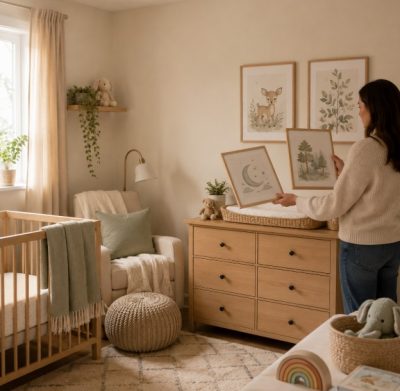
 A few well-chosen prints, paintings, or handmade pieces can turn a simple room into a space that feels personal to the family. But when the nursery is also used for feeding, settling, and sleep, the artwork should work with the room rather than make it feel unnecessarily busy.
Begin With the Room’s Existing Colors
Before buying artwork, look at what is already in the nursery. Wall color, flooring, furniture, curtains, rugs, and bedding form the room’s foundation. Artwork does not have to match these elements exactly. In fact, an overly coordinated nursery can feel more like a showroom than a family space. Instead, look for pieces containing one or two colors that connect naturally with the existing palette.
For example, artwork featuring muted greens can complement a room with natural wood furniture. Soft blue illustrations may work well against warm cream walls. Repeating a few shades creates visual continuity without requiring everything to match.
Choose Subjects With a Gentle Feel
Nursery artwork comes in almost every imaginable theme, from animals and landscapes to vehicles, letters, maps, and abstract shapes. The subject matters less than how it is presented. Simple illustrations with clear forms can provide visual interest without overwhelming a wall. Nature scenes, clouds, plants, stars, friendly animals, and understated abstract designs are common choices because they can suit a nursery without feeling too intense.
Consider the mood of the image rather than choosing something only because it is marketed for babies. A large, highly detailed picture packed with contrasting shapes may dominate the room, while a simpler piece can add character more quietly.
Pay Attention to Color Intensity
Bright colors are not automatically unsuitable for nurseries. Babies and children can enjoy colorful surroundings, and parents don’t need to remove every vivid shade to create a peaceful room.
However, highly saturated colors used across numerous pieces can make the walls look crowded. If the nursery already contains colorful toys, books, and textiles, softer artwork may help balance those elements.
Muted blue, green, peach, dusty pink, warm beige, and earthy shades are easy to incorporate into calm interiors. Brighter colors can appear as smaller accents rather than covering every print.
This keeps the nursery cheerful without making every surface compete for attention.
Consider the Size of Each Piece
Artwork that is too small for a wall can look lost, while an oversized piece can dominate a compact nursery. Before purchasing anything, measure the available wall space. One larger print may create a cleaner appearance than a collection of many small pictures. Alternatively, two or three related pieces can fill a wider area without creating excessive visual clutter.
If you prefer a gallery wall, leave enough space between frames so individual pieces remain easy to distinguish. You don’t need to fill every empty section of wall. Leaving some areas undecorated gives the room visual breathing space.
Be Careful About Artwork Above the Crib
The wall above a crib may seem like the obvious place for nursery artwork, especially because it often appears prominently in room photos. Safety, however, should come before the appearance of the wall.
Don’t place heavy frames, mirrors, shelves, signs, or other objects where they could fall into the baby’s sleep space. Hanging items also need secure installation appropriate for their weight and the wall type.
Parents who want decoration near the crib can consider safer alternatives, such as wall decals or painted designs, while still following current nursery safety guidance. And remember that a blank wall above the crib is perfectly acceptable. Not every space needs decoration.
Use Personal Artwork
Nursery art doesn’t have to come from a children’s décor store. Personal pieces can make the room more meaningful. A simple family illustration, handmade textile, framed piece created by a sibling, or artwork connected to the family’s culture can give the nursery a story. Parents may also choose images inspired by a favorite place, animal, book theme, or family tradition.
Personal items are particularly useful when the rest of the room is intentionally simple. One meaningful piece can provide more character than several generic decorations. Just make sure any handmade or unusual object is displayed securely and out of reach once the baby can reach it.
Think Beyond the Newborn Stage
A nursery changes quickly. The newborn who barely notices the wall art will soon become a toddler with clear interests and opinions. Choosing artwork that can remain relevant beyond the first year may save parents from redecorating the entire room. Nature illustrations, abstract designs, landscapes, animals, and simple graphic prints can often transition easily into a toddler or young child’s bedroom.
Another option is to use frames that make artwork easy to replace. The frames can stay while the pictures change as the child’s interests develop. This approach can make future updates both simpler and less expensive.
Avoid Turning Every Wall Into a Feature
Nursery decorating can easily become excessive because so many appealing products are available. Artwork, name signs, mobiles, shelves, decals, photographs, and decorative objects can accumulate quickly.
Try choosing a focal area rather than decorating every wall equally. A single collection of artwork above a dresser or reading chair may be enough to give the room personality. Other walls can remain quieter or serve practical purposes such as storage. A calm room usually comes from editing, not continually adding more.
Create a Nursery That Feels Comfortable to You
Babies will not judge whether their nursery follows a particular design trend. Parents and caregivers, however, may spend many hours there, including during late-night feeds and early mornings.
Choose artwork that you genuinely enjoy looking at. Trends can inspire, but they do not need to dictate the room.
Artwork alone will not determine how well a baby sleeps, and a calm nursery involves more than decoration. Lighting, temperature, safe sleep arrangements, noise, and practical organization all matter. But carefully selected artwork can support the overall atmosphere. A few meaningful pieces, thoughtfully placed, can make the nursery feel warm and complete without turning it into a space filled with unnecessary visual noise.